
HarborGate is a modular onboarding and compliance API designed to help regulated industries transform manual vendor approval into an orchestrated, AI-native workflow. Instead of shipping a single vertical product, HarborGate provides a machine-readable component architecture, tokenized design patterns, and agent-ready endpoints that can power adaptive UI surfaces across multiple industries. In the Transportation and Logistics industry, HarborGate lets terminal operators and logistics providers validate vendor (truck drivers) credentials, track safety and insurance requirements, and coordinate stakeholder approvals. As the platform evolves, it adds multi-agent task orchestration, intent-based navigation, dynamic layouts, and exception handling, positioning HarborGate as an end-to-end infrastructure layer for compliant, low-friction supplier activation.
client
HarborGate
agency
Independent
Role
Mobile API, 0-to-1 Product Launch, MVP, Founding Designer, UX/UI Strategy, Discovery, Design, Visual Systems, AI-Assisted Design
Prototype Coming Soon
Epic Need: Design and launch a 0-to-1, AI-assisted, industry-agnostic onboarding API for HarborGate that can be reused across sectors, while proving its value through an implementation in the Transportation and Logistics industry. The experience must translate complex system behavior into human-centered flows using adaptive UI surfaces, tokenized patterns, and machine-readable components that AI can reliably compose.
Problem Statement: Industries with complex vendor ecosystems, including Transportation and Logistics, need fast, auditable, policy-complete onboarding that remains resilient to edge cases. Today, onboarding is fragmented across email, spreadsheets, shared drives, and siloed systems. Vendors do not know what is required, what is missing, or what happens next. Internal teams spend time chasing documents, validating policy rules, and manually escalating exceptions, increasing cycle time and compliance exposure.
How might we design an AI-native onboarding platform as an API and composable design system that supports intent-based navigation, multi-agent task orchestration, and dynamic UI composition, while remaining predictable, testable, and auditable for enterprise teams?
Consumer Tension (B2B and B2C):
B2B tension (internal teams, transportation company): Terminal Ops/Operations wants speed so vendors can start work. Safety and Compliance want certainty, traceability, and consistent rule enforcement. Finance wants fewer exceptions and cleaner approvals. But the current process creates back-and-forth, unclear ownership, missed deadlines, and repeated reviews, especially when requirements vary by vendor type, port location, and service category.
B2C tension (vendors, the truck drivers): Vendors want a simple, transparent approval path because delays block jobs and revenue. But they face confusing requirements, repeated requests, unclear status, and inconsistent feedback, which makes them feel blamed for delays they cannot predict or quickly resolve.
What MVP tries to solve: The MVP establishes HarborGate as a reusable API plus an AI-orchestrated UX pattern library, then validates it through a Maritime onboarding flow.
MVP capabilities
Intent-based onboarding entry
Users can start with intent, not a rigid flow: “Get approved to work at this port,” “Upload insurance,” “Fix missing safety training,” “Check approval status.”Adaptive UI surfaces composed from tokens
Instead of static screens, the UI assembles a task surface based on vendor type, port requirements, and document readiness. Components are machine-readable and tokenized, enabling AI to compose layouts consistently.Real-time requirements engine
A rules service calculates the required artifacts for each scenario (e.g., tug services vs stevedoring vs maintenance). The checklist updates live, showing what is required, what is complete, and what blocks approval.Multi-agent orchestration
Intake Agent parses submissions and extracts structured fields
Validation Agent checks policy rules, dates, and thresholds
Doc Chase Agent triggers reminders and next-step guidance
The routing agent escalates exceptions to the right queue and owner
This orchestration drives UI state, not just backend logicException handling and escalation workflows
Route non-response, high-risk flags, and incomplete requirements to a queue with recommended actions and one-click follow-ups.Audit-ready timeline
Log every action as an event stream: uploads, validations, reminders, overrides, approvals, and escalations. This supports audits, reporting, and performance analytics.
Questions to ask
Product + Business goals
What does “successful onboarding” mean (cycle time, compliance pass rate, vendor satisfaction, time-to-first-job)?
What is the target onboarding SLA today vs. the desired future SLA?
Which vendor categories matter most (highest volume, highest risk, highest spend)?
What are the top reasons onboarding stalls (missing docs, review backlog, unclear requirements, repeated rework)?
Users and roles (B2B + B2C)
Who are internal decision makers (Port Ops, Safety, Compliance, Procurement, Finance, Legal)?
What permissions should each role have (view, request changes, approve, override, escalate)?
Who is the vendor user (owner, site manager, admin, subcontractor)?
How many contributors per onboarding, and what collaboration features are needed?
Current workflow and pain points
Walk through the process from invite to approval.
Where does work happen today (email, portal, spreadsheet, shared drive, ERP)?
Where do delays happen most and why?
What does escalation look like today, and what triggers it?
Requirements and policy logic
What documents are required by vendor type, region, service category, and port authority?
What validation rules exist (expiration, coverage limits, certifications, signatures)?
Which requirements are hard blockers vs soft warnings?
What exceptions are allowed, and who can approve overrides?
Status, transparency, and trust
What does a vendor need to see at any moment (status, next steps, deadlines, owner)?
What language should we avoid to prevent blame and confusion?
What vendor questions most often generate support tickets?
What tone should the system use: strict compliance vs supportive guidance?
AI and automation boundaries
What can be safely automated (detection, reminders, routing, summarization, extraction)?
What must remain human-reviewed (final approvals, exception overrides, risk decisions)?
What error tolerance is acceptable (false positives vs false negatives)?
When should the system ask a clarifying question, auto-route, or escalate?
Notifications and escalation
What is the escalation SLA (24h, 48h, 72h), and does it vary by vendor tier?
What channels are allowed (email, SMS, in-app), and what consent is required?
Who receives escalations, and what context is required to act fast?
What one-click action should a queue owner have (request doc, approve, override, schedule call)?
Data, integrations, and constraints
What systems must integrate (ERP, procurement suite, contract management, safety systems, insurance verification)?
Where is the source of truth for vendor status, identity, and documents?
What security constraints apply (SOC2, ISO, GDPR), and what data must be minimized?
Any constraints on file types, size limits, scanning, verification, retention?
MVP scope and rollout
What are the 3 must-have workflows (invite, upload, validate, chase, escalate)?
What is out of scope (payments, full contract authoring, advanced risk scoring)?
Which Maritime vendor segment should pilot first and why?
How will we measure MVP success in 30 to 60 days?
Metrics and instrumentation
What events should be tracked (invite sent, upload started, upload completed, validation failed, reminder sent, escalated, approved)?
What are baseline completion and time-to-approve metrics today?
What is the cost of delay (port schedule impact, missed revenue, compliance exposure)?
What improvement target is realistic (example: 30% faster approvals)?
UX, accessibility, and edge cases
Which accessibility standard must we meet (WCAG level or internal policy)?
What happens if a vendor uploads the wrong document or an expired file?
What if a vendor cannot access the portal (email filters, shared devices, or no login)?
What if Ops needs partial approval due to urgency?
Tech Architecture
Client surfaces
Vendor Portal (adaptive task surface)
Internal Control Plane (queues, approvals, overrides)
API Consumers (other industries integrating HarborGate APIs)
AI Orchestration Layer
Orchestrator: routes tasks based on intent, state, and policy outcomes
Agent outputs are structured (JSON-like) to drive UI composition
Core Agents
Intake Agent: document parsing, field extraction, metadata classification
Validation Agent: rules evaluation, expiry checks, threshold checks, policy matching
Doc Chase Agent: reminder scheduling, guided next steps, vendor nudges
Routing Agent: queue assignment, escalation policy, owner selection
Rules and Data Services
Policy Rules Engine: machine-readable requirements per industry, vendor type, region
Document Store: versioning, retention, access control
Event Log: immutable audit timeline (who did what, when, why)
Integrations
Procurement/ERP
Compliance and Safety systems
Insurance verification
Notification services (email/SMS/in-app)
Observability and Governance
Metrics: time-to-approve, exception rate, SLA breaches, completion rate
Model monitoring: confidence thresholds, error types, human overrides
Feature Matrix
Adaptive UI + Generative Design System
Tokenized patterns for task surfaces, checklists, banners, warnings
Machine-readable component architecture for AI composition
Dynamic layout rules based on intent, readiness, and risk
Agentic OS Interaction Model
Intent-based navigation replacing static onboarding steps
Multi-agent orchestration with clear state transitions
Context panel for guidance, explanations, and next actions
Compliance and Workflow Engine
Policy rules per industry and scenario
Real-time validation and blocking logic
Exception handling with human-in-the-loop overrides
Operations and Governance
Queue-based review and escalation
Audit timeline and exportable reports
Role-based access and approval controls
Integrations and Extensibility
API-first onboarding endpoints for reuse across industries
Webhooks and event stream for downstream systems
Pluggable validation modules per customer requirements
Three Design Decisons
DECISION 1
Where agents act alone and where a human steps in
Seven agents work in sequence, and a final decision agent routes every case to one of four outcomes. Only high-confidence, fully verified cases are approved automatically. Anything ambiguous goes to a person.
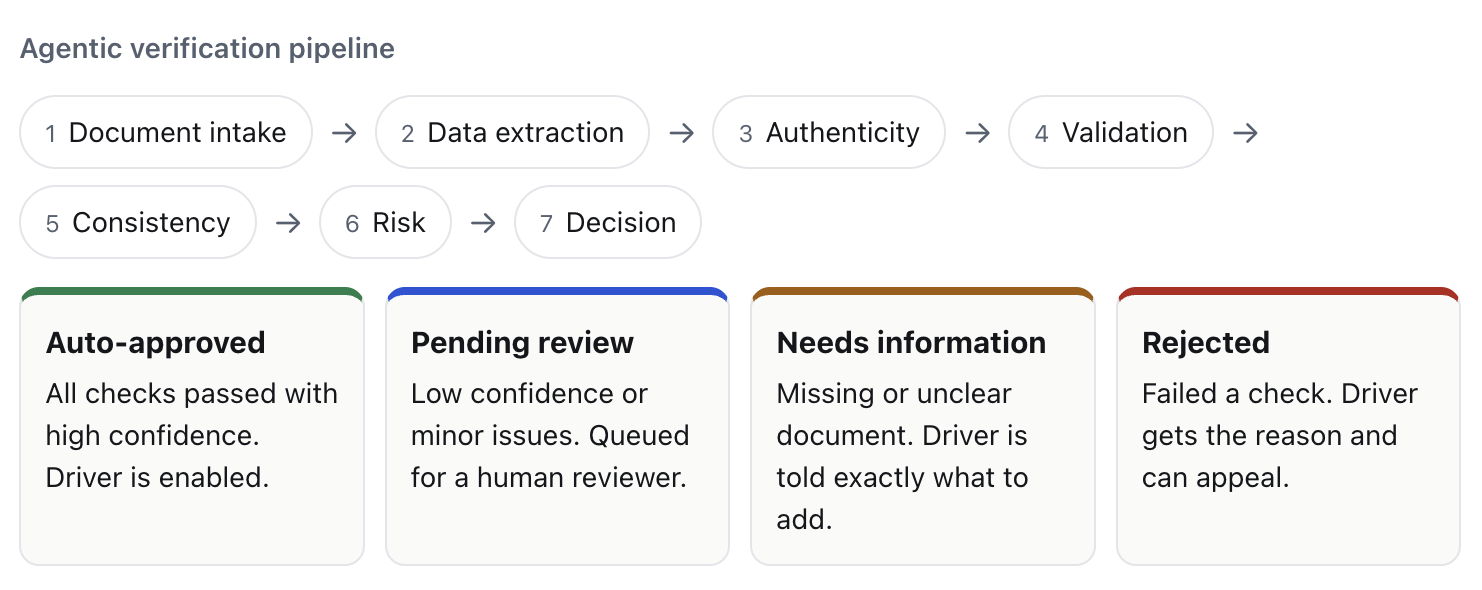
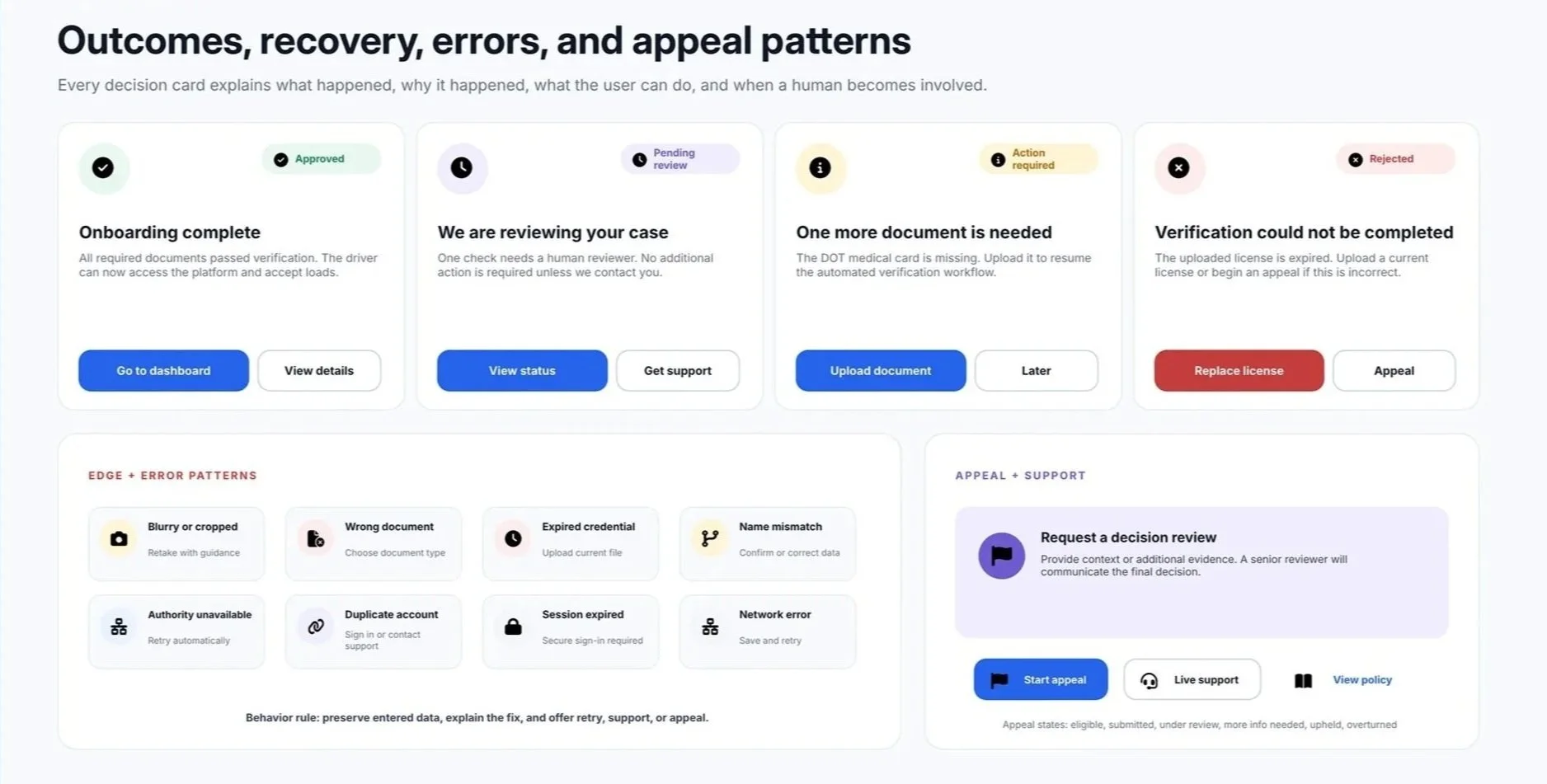
I also mapped the edge cases up front: blurry or cropped photos, wrong document type, expired licenses, name mismatches across documents, duplicate accounts, suspected fraud, and the state authority system being unavailable.
How I ensure that AI Agents are working
DECISION 2
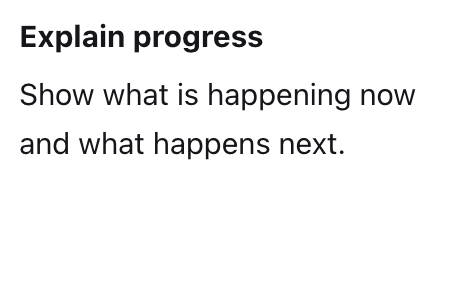
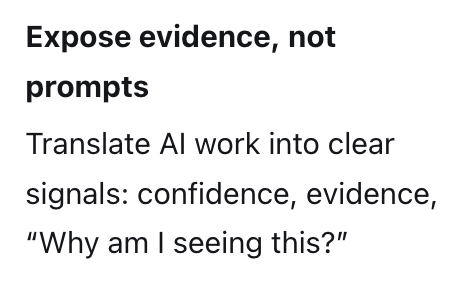
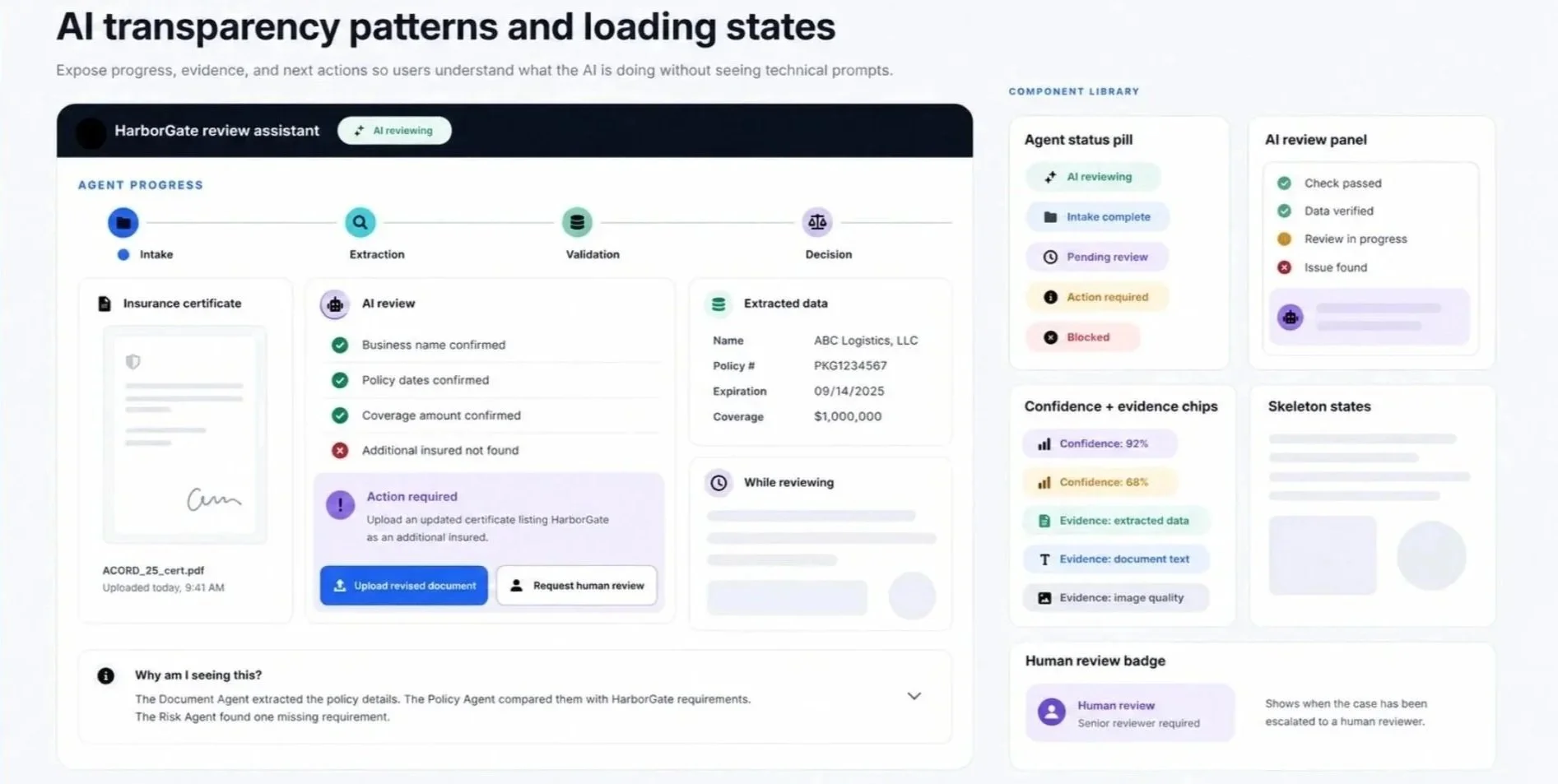
Make the AI visible, not mysterious
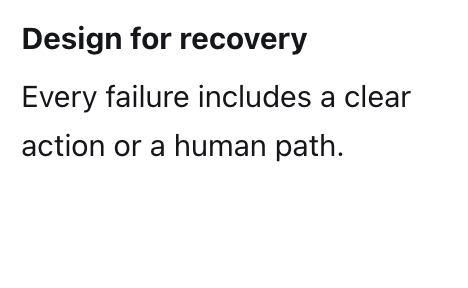
Drivers and reviewers see what the system is doing and why. Three principles guided every pattern:
DECISION 3
Recovery over rejection
Every outcome states what happened, what the driver can do next, and when a human becomes involved. Entered data is preserved, and each failure offers a retry, live support or a formal appeal. A failed verification should feel recoverable, never opaque.
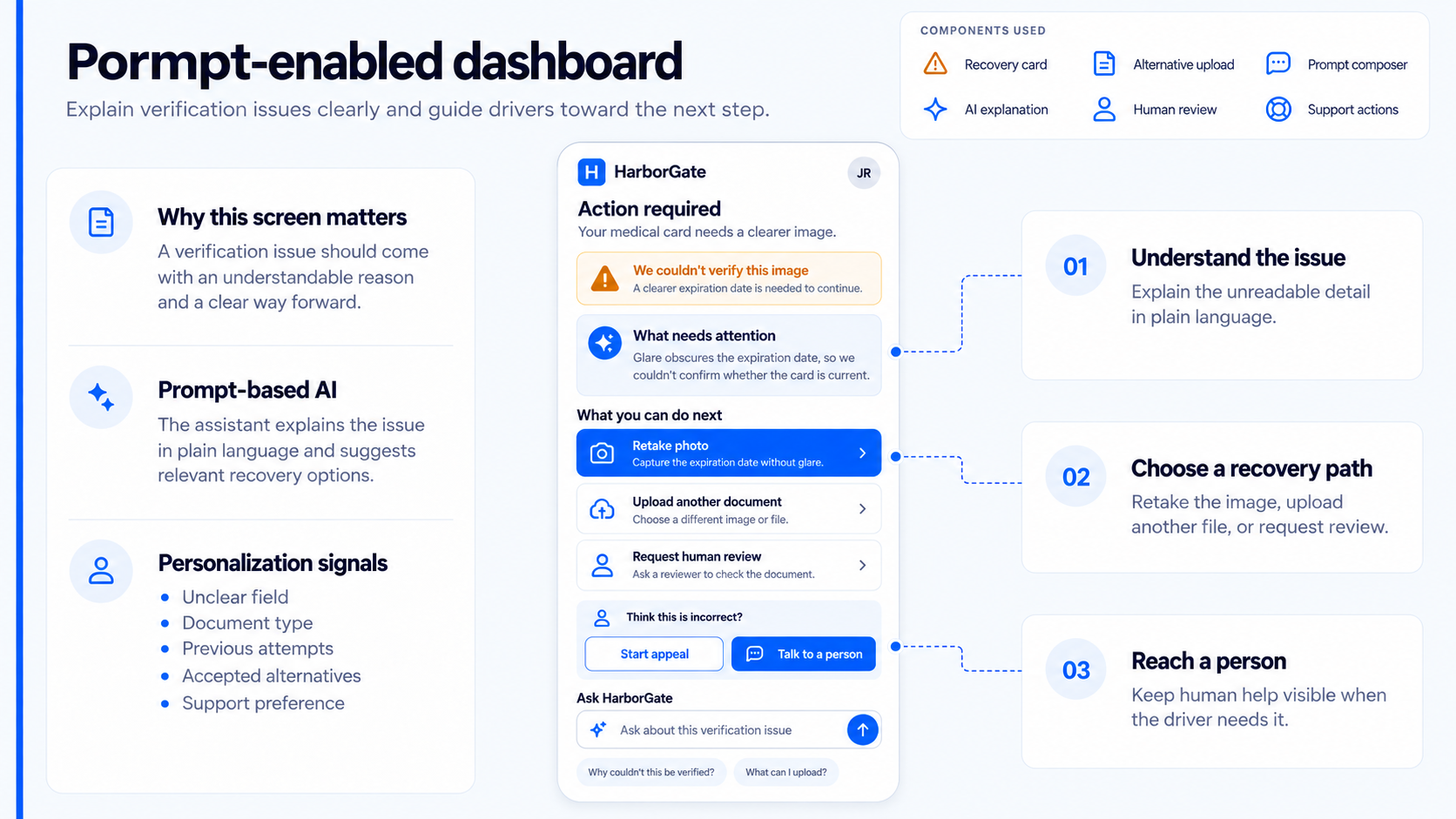
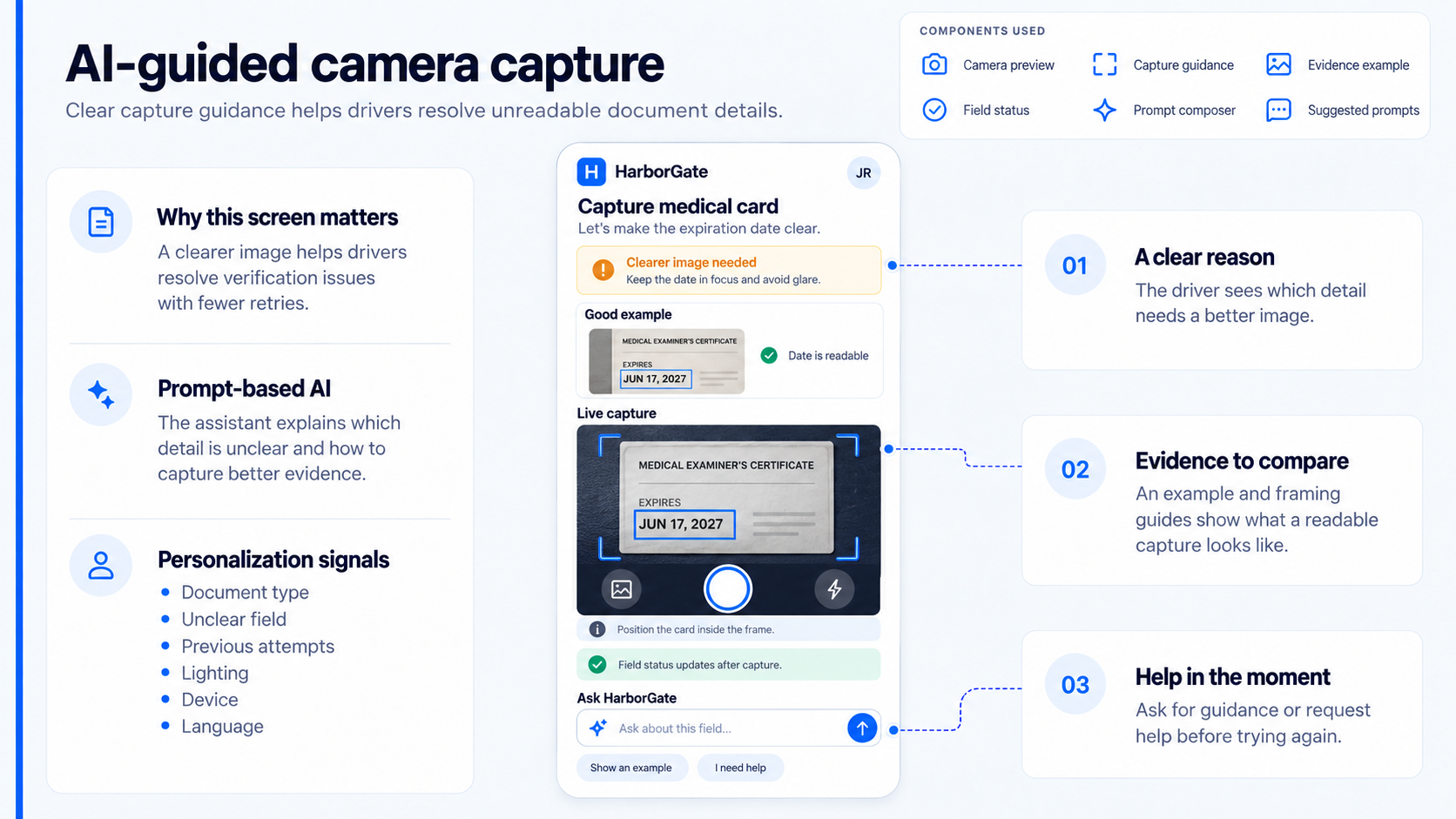
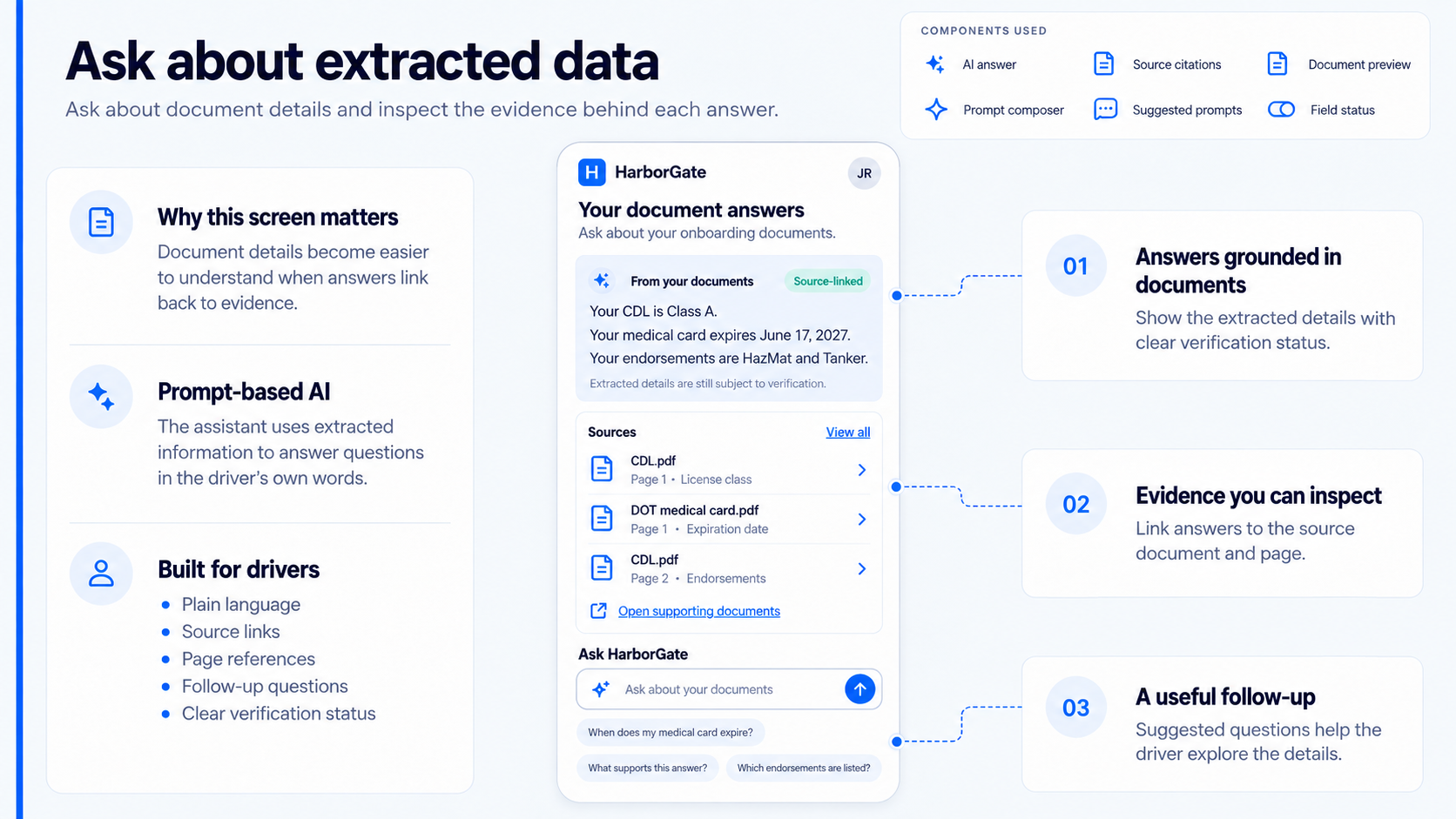
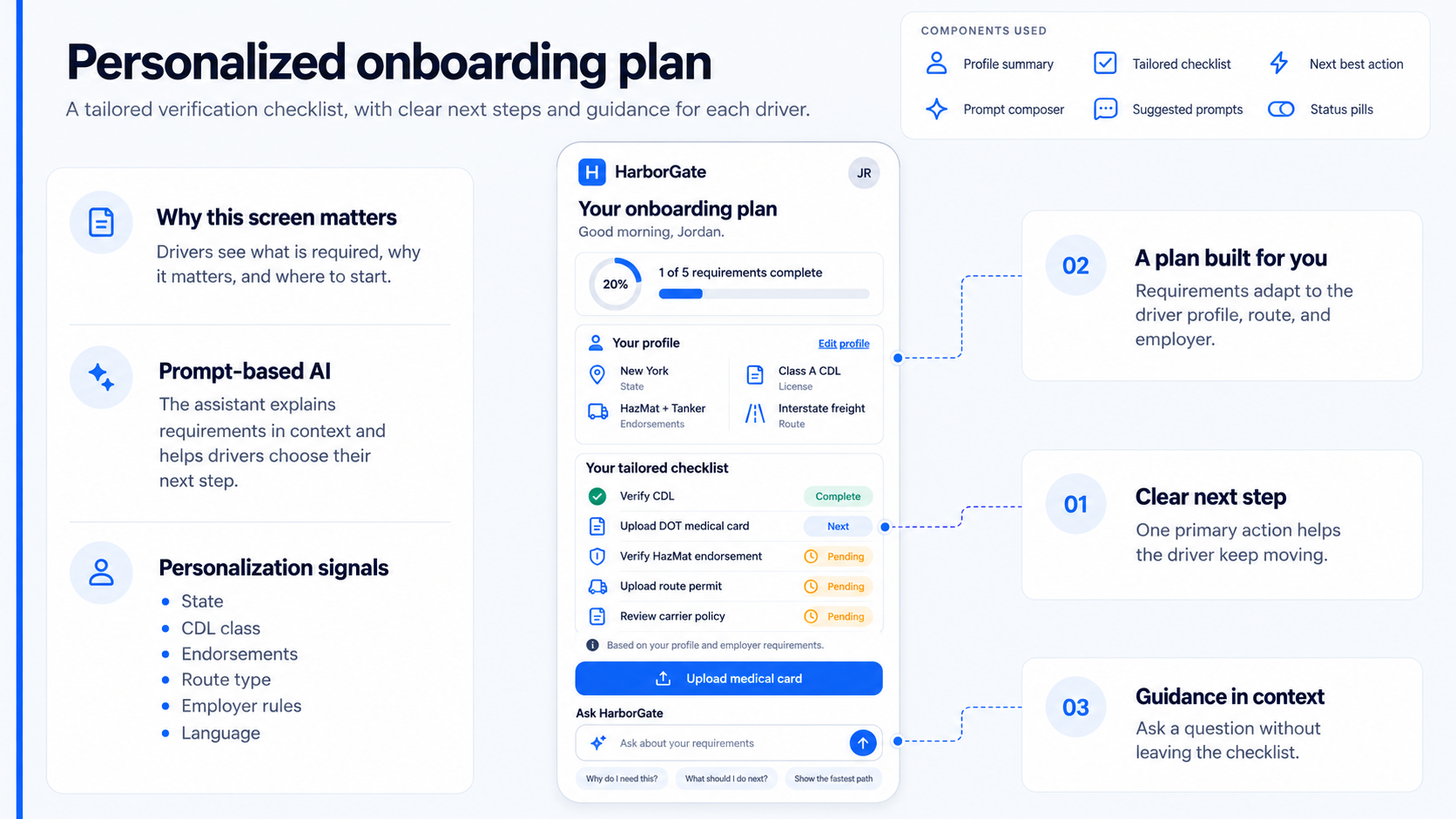
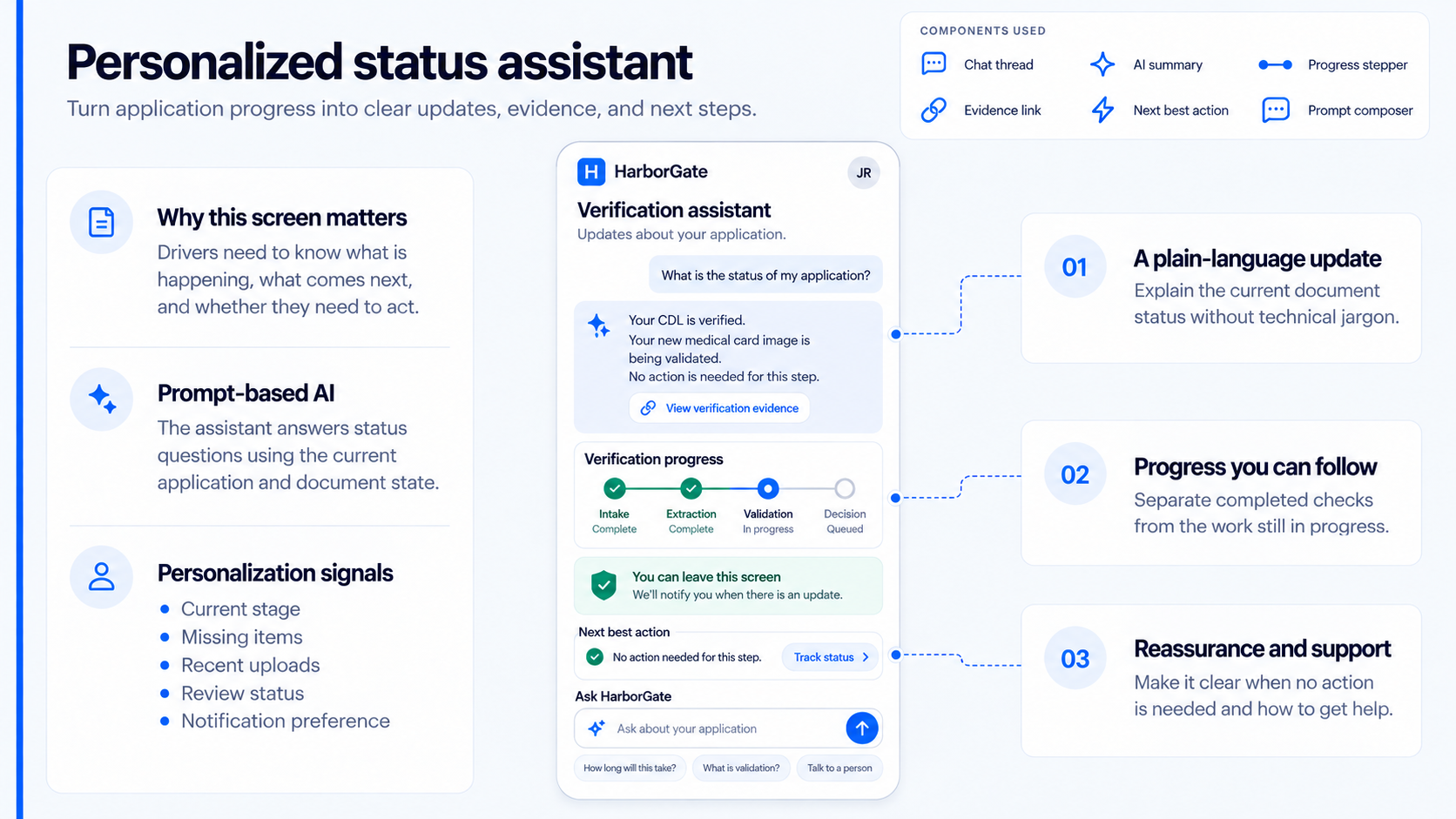
The Driver’s Experience
Concept only, not final UI screens
What I accomplished:
1.
Designed a unified, AI-assisted driver onboarding flow that connects personalized requirements, document capture, verification, recovery, and status updates into one clear experience.
2.
Translated complex AI workflows into understandable interactions through contextual prompts, source-linked answers, transparent progress states, and clear options for human review.
3.
Created a cohesive mobile design system across five key screens, standardizing HarborGate branding, typography, spacing, reusable components, and AI prompt interactions.